
The French furniture market is undergoing a period of restructuring. Between the rise of reuse, closely followed by ADEME, which now publishes a report dedicated to reused furniture items, and the regulatory framework for the collection of used furniture by retailers, purchasing conditions have changed.
The choice of a sofa, table, or chair is no longer solely a matter of personal taste. It is part of a journey where sustainability, supply chain, and spatial coherence weigh as heavily as aesthetics.
Reuse and furniture collection: what the regulations change for the buyer
Before browsing catalogs, a step often overlooked is to check what the retailer offers in terms of collection. In France, the extended producer responsibility regulates the collection of furniture items: depending on the size of the store and the sales conditions, the retailer may be required to take back a used piece of furniture for free when purchasing an equivalent product.
This obligation alters the budgeting logic. An old sofa or wardrobe that one doesn’t know what to do with no longer hinders renewal. Asking about collection options at the time of ordering allows this option to be integrated into the delivery schedule and avoids separate removal fees.
Reuse itself is gaining visibility. ADEME now follows this sector as a distinct circuit, not just a simple trick. Comparing second-hand, repair, or donation offers before making a new purchase is no longer a marginal gesture; it is a step in the buying journey that brands are beginning to integrate. To learn more about Maison Du Meuble, their ranges illustrate the diversity of choices available between new and structured second-hand.
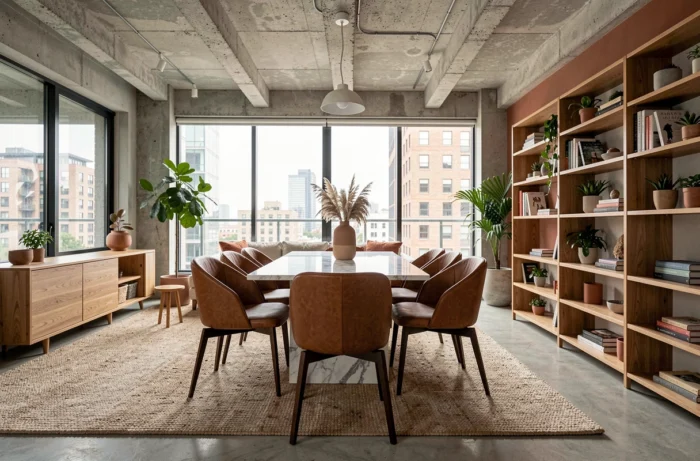
Coherence of materials and colors in the same space
Competitors are multiplying lists of decorative styles (Scandinavian, industrial, bohemian) without addressing the real difficulty: making pieces of furniture purchased at different times, sometimes second-hand, coexist in a space with fixed proportions.
Coherence does not come from a single style applied rigidly. It relies on a material thread. Three questions help define it:
- What dominant material structures the room (light wood, metal, stone)? This material should appear on at least two pieces of furniture or surfaces to create a visual unity.
- What color palette limits contrasts? Two or three base shades are sufficient. Adding an accent color on a chair or cushion creates relief without disorder.
- What level of finish connects the pieces together? A raw solid oak piece and a glossy lacquered console in the same room create a visual tension that is difficult to resolve, even if both are of high quality.
A material thread avoids inconsistencies more surely than an imposed decorative style. A living room can mix eras if the wood, fabric, or metal share a common tone.
Furniture proportions and circulation in the room
The most common trap is not bad taste. It is poor sizing. A sofa that is too deep in a modestly sized living room blocks circulation and visually overwhelms the rest of the furniture. A dining table that is too narrow for the number of guests makes every meal uncomfortable.
Measuring the available space before choosing a piece of furniture seems obvious, but most layout errors come from an impulsive purchase made in-store or online without prior measurements. The floor plan, even a rough one, remains the best decision-making tool.
Passage areas and minimum distances
For a room to remain functional, the passage areas between furniture must allow for smooth circulation. Between a sofa and a coffee table, sufficient space to stand up without contortion changes the daily use of the living room. Behind the chairs at a dining table, allow enough space for someone to pass without disturbing seated guests.
These physical constraints take precedence over aesthetics. A perfectly chosen piece of furniture but poorly sized for the room becomes an obstacle. Free 3D simulation tools, available on the websites of several furniture retailers, allow testing a layout before ordering.

Durability of furniture: what the reparability index does not yet cover
Since 2025, the durability index has replaced the reparability index for certain devices such as televisions and washing machines. This evolution broadens the assessment beyond mere ease of repair to reliability and wear resistance. Furniture, however, is not yet covered by this system.
This absence creates a blind spot for the buyer. No official index measures the durability of a sofa or table. Existing labels (NF Furniture, for example) focus on safety or mechanical resistance, not on the overall longevity of the product.
While awaiting a possible regulatory extension, some practical guidelines help assess the sturdiness of a piece of furniture:
- The type of assembly (tenon-mortise, dowel, screw) directly influences longevity. Glued and screwed joints hold up better than simple pressure fittings.
- The density of the seat foam in a sofa determines its comfort over several years. Foam with too low a density collapses within a few months of daily use.
- The ability to replace a component (cover, cushion, leg) extends the life of the furniture without a complete repurchase.
Prioritizing a repairable piece of furniture or one with replaceable parts remains the most concrete lever in the absence of official ratings. Some manufacturers are beginning to display the availability of spare parts, a criterion to check before purchasing.
Furnishing a home with style is not limited to choosing between two decorative trends. The regulatory collection of old furniture, the material coherence between pieces, the appropriate sizing for the space, and the actual durability of the furniture form a more solid decision-making framework than a list of visual inspirations. These four axes, taken together, guide choices that stand the test of time, both aesthetically and practically.