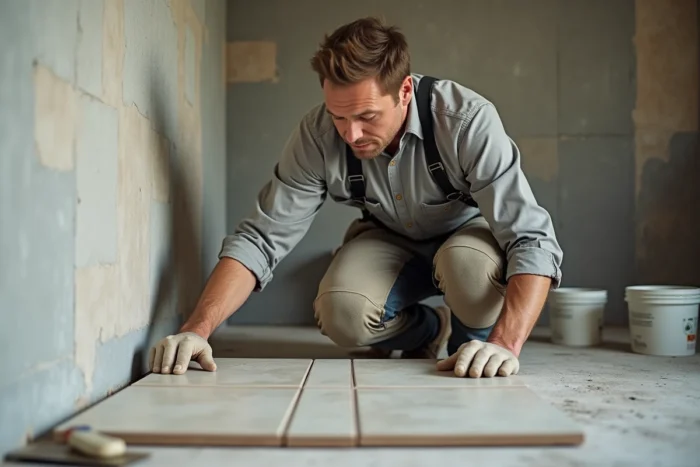
The fiberglass mat already covers the wall, and the backsplash or wall tile project comes afterward. This question often arises in kitchens and bathrooms where the mat has been installed to hide surface defects. Installing tiles over it is technically feasible, but the answer depends less on the mat itself than on what is underneath and what has been applied on top.
Wall support cohesion under the fiberglass mat: the real decision criterion
DIY forums repeat that the mat just needs to be “well glued.” This phrasing is misleading because it only considers a single layer. The tiling does not only pull on the mat: it stresses the entire chain, from the raw wall to the last layer of paint.
Before gluing any tile, the strength of each layer must be assessed. The load-bearing wall (plaster, cement, drywall) must be sound, without any crumbling areas. The fiberglass adhesive must still fulfill its gripping function. The mat must neither peel nor bubble. And any paint should not powder.
A simple test can verify this overall cohesion: scratch the surface in a cross pattern with a metal point. If the top layer crumbles or peels off in flakes, the tiles should not be installed directly. It is then necessary to sand down to find a stable layer, or even remove the mat if the whole thing is crumbling.
The question of installing tiles on fiberglass mat is therefore resolved by a complete diagnosis of the support, not by a simple visual check of the mat.
Painting on fiberglass mat and tiles: frequent incompatibility
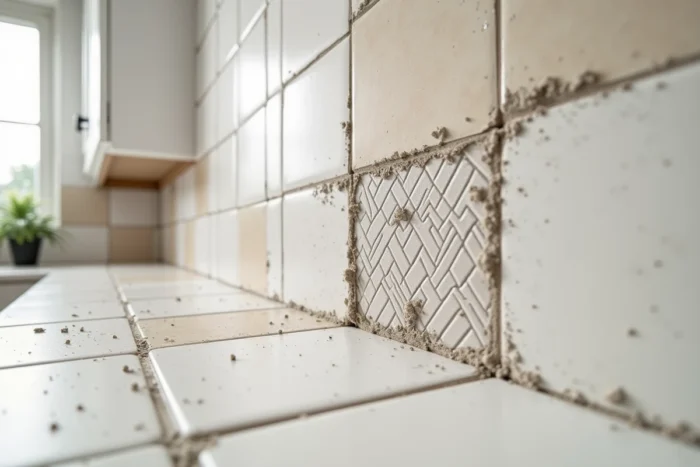
Most wall fiberglass mats are painted, sometimes in several layers. This detail radically changes the situation. A satin or glossy acrylic paint creates a smooth film on which tile adhesive does not grip well.
Two situations arise:
- The mat is raw or painted with a single layer of matte paint: the surface remains sufficiently porous for the adhesive to penetrate the weave. A light sanding with medium-grit paper further improves adhesion.
- The mat has several layers of paint, especially if the last layer is satin or glossy: the plastic film prevents any penetration of the adhesive. Deep sanding or the application of an appropriate primer becomes necessary.
- The mat has been covered with a smoothing compound: this additional layer adds a risk of intermediate detachment. It must be verified that the compound holds firmly on the mat before considering installation.
A mat painted in several glossy layers is the most unfavorable case. Scraping, sanding, vacuuming the dust, then applying a primer: these steps take time, but they condition the long-term hold of the tiles.
Choice of adhesive and tile format on fiberglass mat
The fiberglass mat does not offer the same rigidity as a cement coating or a waterproof drywall. It remains a flexible, glued support that can absorb the micro-vibrations of the building. The choice of adhesive must take this flexibility into account.
A flexible adhesive (rated C2S1 or equivalent) is recommended rather than a standard rigid adhesive. Flexible adhesives compensate for slight movements of the support and reduce the risk of gradual detachment. A classic adhesive mortar, which is too rigid, can break the bond on a support that moves, even slightly.
The weight of the tile also matters. Favoring lightweight and small-format tiles limits the load on the mat. Large formats (over 30 x 60 cm) exert greater tension and increase the risk of tearing, especially on a vertical support. Thin ceramics or standard wall tiles remain the most suitable options.
Double gluing (adhesive on the wall and on the tile) is recommended to maximize the contact surface. This technique prolongs the installation but secures the adhesion on a support that is not perfectly flat.
When to remove the fiberglass mat before tiling
Installing over the existing mat is not always the right decision. Several signals should guide a straightforward removal.
If the mat is buckling in places, if it lifts when touched, if the wall sounds hollow behind it: installing tiles over it will only worsen the problem. The weight of the tiles will accelerate detachment, and the repair will be more costly than a preventive removal.
In a humid room like a bathroom, removal is often preferable. The fiberglass mat is not a vapor barrier. Water can migrate between the mat and the wall, weaken the adhesive, and cause a block detachment, including the tiles. Installing a waterproofing system under tiles (like SPEC) on a fiberglass mat makes no technical sense: the waterproofing system must adhere to a solid support.
The removal of the fiberglass mat is done by prolonged moistening (hot water or steam stripper), followed by scraping with a painter’s knife. The bare wall must then be prepared: filling, sanding, priming. This additional work takes a day, but it guarantees a reliable support for years.
Tenant case: permission and restoration
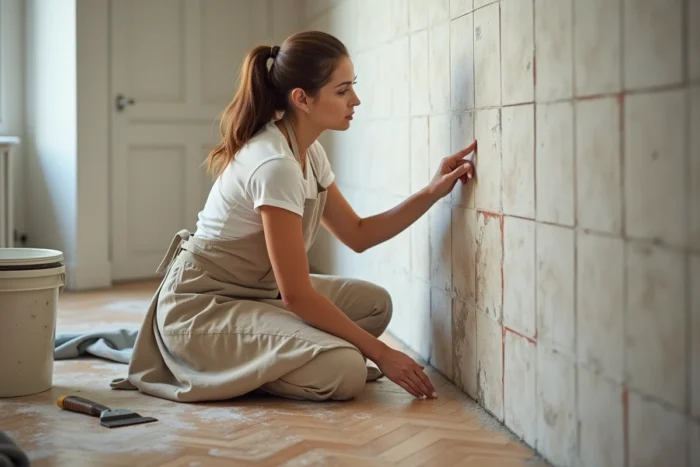
A tenant considering tiling a wall covered with fiberglass mat must take the lease into account. Installing wall tiles constitutes a modification of the dwelling that exceeds routine maintenance. Permission from the landlord is necessary before any work of this type.
Without written agreement from the owner, the tenant risks a request for restoration of the premises upon departure. Removing tiles glued to fiberglass mat generally destroys the mat and damages the wall underneath, which implies a complete restoration at the tenant’s expense.
Reversible alternatives (adhesive backsplashes, clip-on wall panels) should be considered when the lease does not allow permanent modifications. They do not offer the durability of tiles, but they avoid disputes when leaving the property.
The technical feasibility of tiling on fiberglass mat depends on the quality of the complete support, the type of paint in place, and the chosen tile format. When the mat is securely glued to a sound wall, the surface is properly prepared, and the adhesive used is flexible, the result can hold. When one of these links is missing, it is better to remove the mat and start from the raw wall.