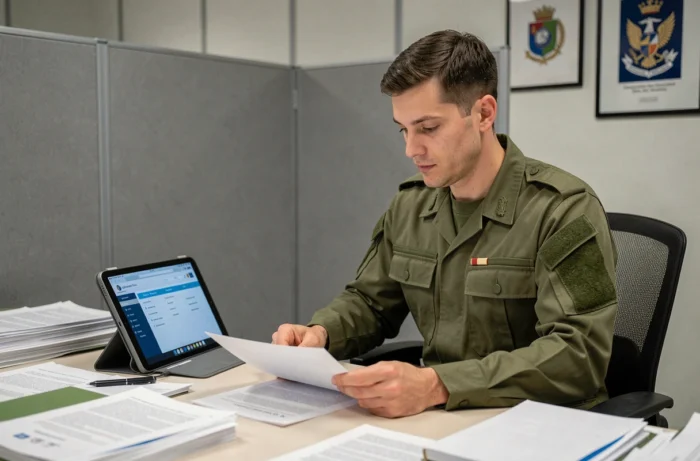
The right to military clothing is based on a points allocation mechanism, the balance of which, the allocation rules, and the ordering conditions vary according to several administrative parameters. Understanding what determines the amount available in one’s e-clothing account, and what can block an order despite a functional connection, helps avoid the most common misunderstandings.
Factors that Determine the Right to Clothing on e-clothing
Accessing the portal does not guarantee an active ordering right. Several variables condition the actual opening of the clothing booklet and the volume of points allocated. Blockages often occur at this level, not at the technical level.
| Parameter | Impact on the Right | Example of Blockage |
|---|---|---|
| Assignment Unit | Determines logistical attachment and distribution point | Recent transfer not synchronized in the ANNUDEF directory |
| Rank | Influences the volume of the annual allocation | Rank change not reflected in the profile |
| Type of Contract | Reservists, contractors, and career military personnel do not have the same rights | Reservist with inactive or non-renewed contract |
| Status of Allocation | The remaining points balance conditions the possibility to order | Allocation fully consumed before renewal |
| Army of Affiliation | The e-clothing deployment schedule varies by army | Access still restricted for certain joint services |
This table summarizes the five main parameters. In practice, a poorly synchronized profile blocks the order even if the connection works. Checking these elements should precede any attempt at technical troubleshooting.
To view the details of one’s balance and understand the distribution between consumed and remaining rights, it is possible to access the Defense e-clothing account from any workstation connected to the network or via offline access.
Scope of the e-clothing Portal: Concerned Armies and Deployment Schedule
The e-clothing portal was not opened simultaneously to all armed forces. The Air and Space Force and the National Navy were the first to be served. The extension to the Army, the DGA, and joint services dates back to October 2023, with a gradual opening between weeks 47 and 48 of that year.
This staggered deployment involved the temporary suspension of the old DPC AT portal and the transfer of order histories to the new individual clothing booklets. Affected military personnel had to anticipate their orders before the closure date of the old system.
Practical Consequences of Data Transfer
The transition from one system to another generated temporary inconsistencies in points balances. Some order histories were not immediately visible after migration. Military personnel from the FOT (land operational force) gained access to the portal starting November 20, 2023, while the rest of the Army followed in week 48.
For reservists, the situation remains more complex. The right to order depends on the activation of the contract and synchronization with the ANNUDEF directory. A reservist whose contract is not up to date in the system will not see their clothing booklet, even if they manage to connect via MinDefConnect.
MinDefConnect Login and Authentication to the Military Portal
Access to the e-clothing portal goes through MinDefConnect, the centralized authentication system of the Ministry of the Armed Forces. This portal relies on the ANNUDEF directory, which contains the identifiers and profiles of all military personnel.
Two access modes coexist:
- From the Defense network (Intradef): authentication is simplified, the workstation certificate validates part of the identification
- From an external network (home, civilian network): the user must enter their complete MinDefConnect identifiers, possibly with two-factor verification
- In international mobility situations (for deployed reservists): degraded procedures exist, but they do not always allow for placing orders
The most common connection issues do not stem from the e-clothing portal itself, but from the upstream authentication chain. An expired ANNUDEF password or a profile not migrated to MinDefConnect 2.0 is enough to block access.
Verification Points Before Contacting Support
Before opening a ticket, three quick checks eliminate the majority of blockages:
- Test the MinDefConnect connection on another ministry service (for example, the HR portal) to isolate a global account issue
- Check that the browser accepts cookies and does not block redirects between MinDefConnect and the e-clothing portal
- Verify the validity of the ANNUDEF password, which expires according to a cycle defined by the ministry’s security policy
If the MinDefConnect connection works on other services but fails on e-clothing, the problem lies at the level of the clothing profile (rights not assigned, unit not attached, or booklet not created).

Uniform Wearing Obligation and Logic of Clothing Rights
The right to clothing is not considered a benefit in kind. Wearing a uniform is mandatory while on duty, unless otherwise decided by a competent authority. This obligation legally grounds the allocation: the institution provides the items because it mandates their wear.
The points management reflects this logic. Each military personnel receives an annual allocation calibrated according to their function, their army of affiliation, and their missions. Specific items related to certain missions (ballistic protection, combat uniforms adapted to the theater of operations) fall under complementary allocations, distinct from the standard clothing booklet.
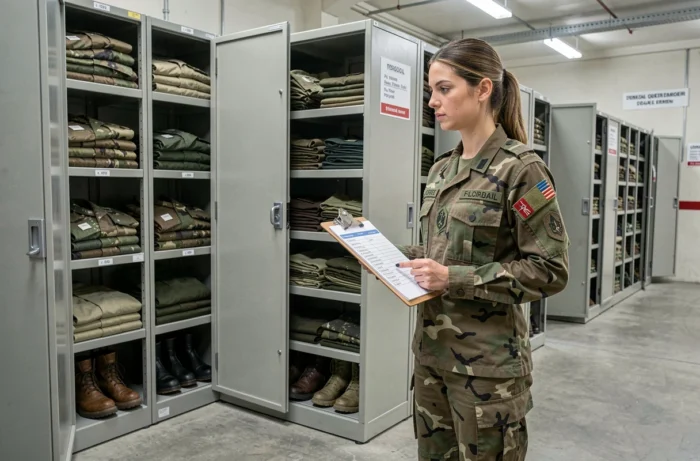
The Army Commissariat Service (SCA) oversees the entire system. Orders placed on e-clothing are not shipped to the military’s home: the pickup occurs at the distribution point attached to the unit, often by appointment or dedicated time slot. This logistical circuit explains why there is a delay between the validation of the cart and the actual receipt of the items.
Monitoring consumed and remaining rights directly on the portal remains the most reliable way to plan orders before an inspection or a change of assignment, two moments when clothing compliance is systematically checked.