
Typing “best weather site” into a search engine returns dozens of contradictory rankings. The problem is structural: the reliability of a forecast depends on the weather model used, the geographical area concerned, and the targeted time horizon. Looking for a universal winner is akin to comparing tools designed for different purposes. To choose a forecasting service suitable for daily life in France, one must first understand what happens under the hood.
Weather Models: AROME, GFS, and ECMWF do not cover the same needs
Behind every weather site runs one or more numerical forecasting models. Three models consistently appear in services accessible from France: AROME, GFS, and ECMWF.
AROME is Météo-France’s high-resolution model, designed for short-term forecasting over the metropolitan territory. Its spatial resolution allows it to capture local phenomena (isolated thunderstorms, coastal breezes, relief effects in the Alps or the Pyrenees). However, it does not cover long-term forecasts.
GFS, produced by the American weather service, offers longer-range forecasts for the entire globe. Its grid is coarser, making it less precise for anticipating a thunderstorm in the Loire Valley or a localized shower in Nouvelle-Aquitaine.
ECMWF (European Centre for Medium-Range Weather Forecasts) is often regarded as the most effective model for forecasts ranging from three to ten days. Several French sites rely on its data without always clearly mentioning it. When an online comparison seeks to determine the reliable weather site in France, this question of the underlying model is rarely asked, even though it directly conditions the relevance of the displayed result.
A site that aggregates multiple models and displays them transparently gives users more control than a service that publishes a single temperature without specifying its source.

Update Frequency: An Underestimated Criterion for Short-Term Forecasts
Most users check the weather for the next few hours or the following day. For this use, the frequency of data updates is as important as the model.
A site updated several times a day adjusts its forecasts based on new radar and satellite observations. A service that publishes a single daily update, oriented towards long trends, will be less responsive to rapid changes, typical of thunderstorm episodes in northern or western France.
Météo-France regularly updates its alerts and forecast maps, making it a suitable tool for near real-time monitoring. Other platforms like La Chaîne Météo or Météo-Villes also offer frequent refreshes, but the conditions vary depending on the sections consulted.
What Frequency Doesn’t Tell You
A frequent update does not guarantee accuracy. If the underlying model struggles to capture a local phenomenon (foehn effect in the mountains, coastal fog), the update will repeat an error instead of correcting it. Cross-referencing two sources remains the most reliable method for uncertain situations.
Choosing a Weather Site Based on Terrain: City, Coast, Mountain
Online rankings treat France as a homogeneous block. The territory presents major meteorological disparities that make some tools more relevant than others depending on where one is located.
In Urban and Plain Areas
Major generalist services (Météo-France, La Chaîne Météo, Météo-City) provide sufficiently accurate forecasts for Paris, Lyon, Bordeaux, or the large agglomerations in the north. Observation stations are dense there, and the models are well calibrated. For a workday or a night out in the city, the difference between two sites will often be marginal.
On the Coast and for the Beach
Coastal areas experience rapid variations due to marine winds and tides. A site that incorporates maritime data (sea state, wind strength, UV index) provides value that generalist platforms do not always cover. Météo-France offers dedicated “sea and beach” bulletins, a service that most aggregators do not replicate.
In the Mountains (Alps, Pyrenees, Massif Central)
The mountains are where the reliability gaps between services are most pronounced. Relief effects, temperature inversions, and valley microclimates put models to the test.
- AROME, thanks to its fine grid, captures altitude thunderstorms and localized snowfall better than global models like GFS
- Specialized forums (like those dedicated to the Alpes-Maritimes or ski resorts) report that field feedback diverges on reliability depending on the valleys, confirming that no site dominates everywhere
- For hiking or skiing, consulting both Météo-France and a service displaying raw outputs from the ECMWF model helps identify uncertainties rather than relying on a single “sun” or “cloud” icon
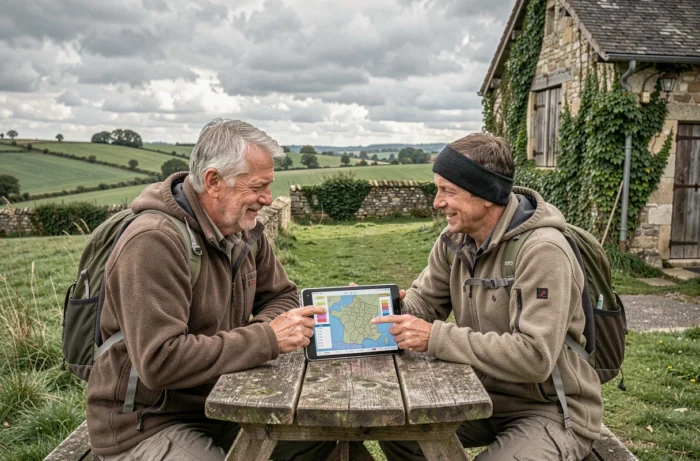
Météo-France as an Ecosystem: Beyond the Public Site
Météo-France is not a single site. The public establishment links to several specialized services: mobile applications, alert bulletins, seasonal forecasts, forest weather, climatological data. A reliable source can be an ecosystem of products rather than a single portal.
This architecture explains why some users find the main site less intuitive than private aggregators: the information exists, but it is spread across multiple pages and subdomains. Third-party applications simplify access by aggregating this data, sometimes at the cost of losing context (disappearance of uncertainty levels, absence of heatwave or thunderstorm alert maps).
Framework for Choosing Your Forecast Source
Rather than a ranking, here are the criteria to check before relying on a weather service daily:
- Does the site specify which weather model feeds its forecasts (AROME, GFS, ECMWF) or does it display a result without an identifiable source?
- Is the update frequency suitable for your use: morning consultation for the day, or real-time monitoring for an outdoor activity?
- Does the service provide data specific to your area (marine bulletins, mountain alerts, storm maps, heat index)?
- Does the site display a level of uncertainty or present each forecast as a certainty, even for seven days ahead?
A service that hides its limitations inspires less confidence than one that displays them. The available data do not allow for designating a universally superior site for the entire French territory. The most reliable choice remains the one that corresponds to your terrain, your time horizon, and your tolerance for the risk of error.