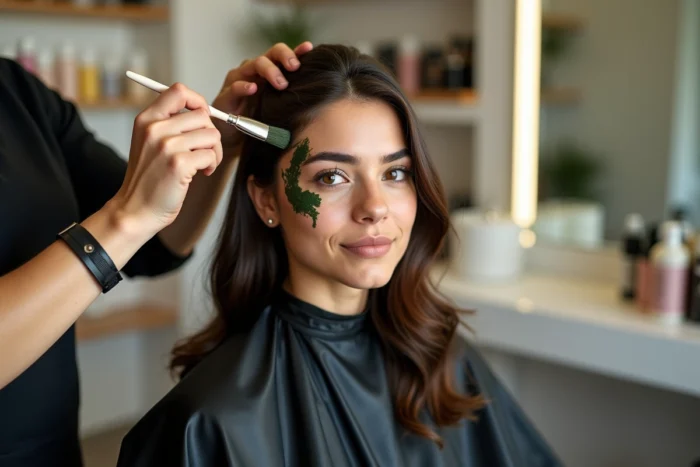
Henna is applied to brown or black hair in hopes of achieving a vibrant auburn, only to find a barely perceptible reflection indoors. The disappointment often stems from an expectation that is misaligned with the starting base.
Lawsone and Keratin: Why Henna Does Not Lighten Dark Hair
Pure henna (Lawsonia inermis) deposits a pigment, lawsone, which binds through stable bonding to keratin at acidic pH. This molecule contains no oxidizing agents. Therefore, on a black or brown base, it cannot remove or lighten the existing melanin.
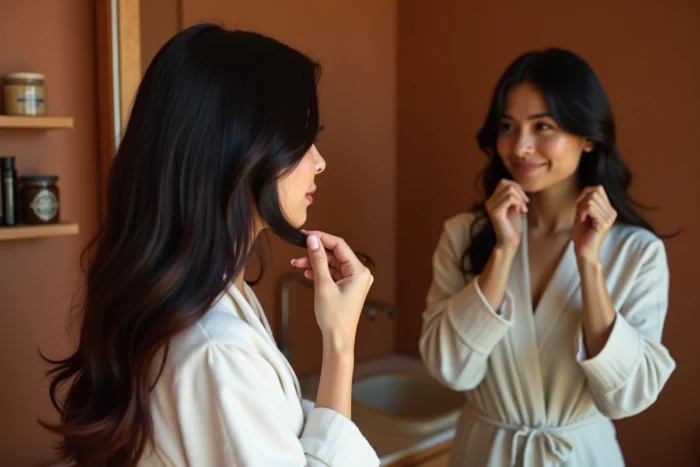
In practical terms, a translucent red-orange filter is layered over a very dark background. The visible result entirely depends on the contrast between these two layers. On medium brown hair, the contrast is sufficient for coppery highlights to appear in natural light. On dark brown or black hair, the henna pigment is drowned out by melanin and only reveals itself in full sunlight, appearing as subtle mahogany highlights and increased shine.
This deposit-based coloring mechanism (as opposed to chemical penetration) also explains why one can better understand the result of henna on black hair by comparing two strands under direct light rather than indoors. The difference between “nothing has changed” and “a beautiful subtle mahogany” often lies in the lighting, not the application.
Pure Henna or Henna-Indigo Mix on Brown Base: Two Very Different Results
The most common confusion concerns the distinction between pure henna and coloring mixes sold under the names “brown henna” or “black henna.” The two products have different objectives.
Pure Henna on Black Hair
It provides shine, a denser feel to the hair, and warm highlights that are only noticeable in sunlight. Indoors, the color change remains almost invisible. For those seeking a conditioning treatment with a subtle aesthetic bonus, this is the right choice.
Henna and Indigo Mix to Darken or Cover
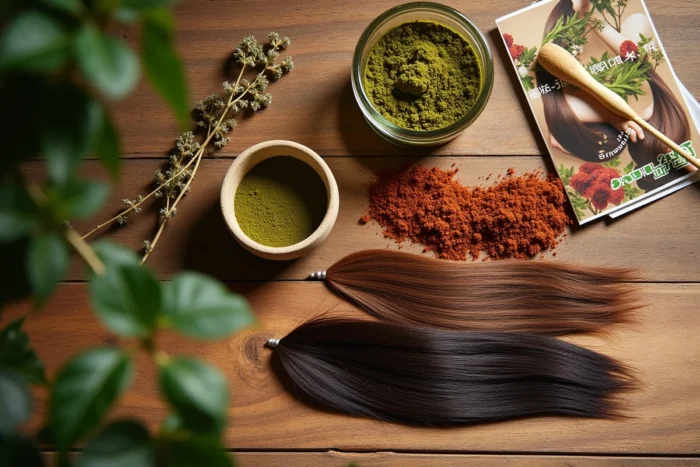
To achieve a deep brown, cool brown, or bluish black, henna must be combined with indigo (Indigofera tinctoria) or other dyeing powders like katam. This process often occurs in two stages: an initial application of pure henna, followed by a second application of indigo on the still fresh henna.
- A ratio with more indigo than henna results in a cool brown to black, with few residual reddish highlights.
- A balanced ratio between henna and indigo produces a warmer chocolate brown, with possible auburn undertones.
- Indigo alone, without a prior layer of henna, does not hold well on hair and can sometimes turn green: the henna base serves as an anchor for the blue pigment of the indigo.
Feedback on this point varies according to the quality of the powders and the porosity of the hair, but the two-step logic remains the most reliable method for achieving a uniform brown.
Cumulative Effect of Henna on Dark Hair: Anticipating Darkening
A rarely highlighted aspect in general guides: henna gradually darkens the color with each new application. On an already brown base, this cumulative effect can lead to a result darker than expected after several close applications.
Yemeni henna, for example, is described as particularly intense in this regard. If starting from a medium brown and continuously applying it to all lengths, one can end up with very dark brown in a few months without having anticipated it.
To limit this darkening, one can adopt a simple strategy: apply henna only to the roots after the initial full applications. The lengths already saturated with pigment do not need an additional layer. Stretching henna onto the ends each time is akin to stacking colored filters on a background that doesn’t need it.
Henna Coloring on White Hair Mixed with a Brown Base
This is the situation where henna gives its most visible results on dark hair. White hair, devoid of melanin, fully absorbs the henna pigment and appears orange to copper. The rest of the brown hair takes on more discreet highlights.
The contrast can be pleasing or unsettling. It creates a natural “coppery highlights” effect without going through bleaching. To soften this contrast and achieve more uniform coverage on white hair, one returns to the henna-indigo mix:
- An initial application of pure henna, which colors the whites orange and prepares the anchor.
- A subsequent application of indigo, which transforms the orange into brown and harmonizes the result with the natural base.
- On very white hair mixed with dark brown, it may sometimes be necessary to repeat the process for the coverage to become uniform.
Lawsone binds almost irreversibly to keratin. Henna does not wash out like a semi-permanent dye: it fades very slowly over time, and only regrowth brings back the natural color. On whites colored bright red by pure henna, a change of mind requires covering with indigo rather than waiting for it to fade.
Before diving in, keep in mind that henna on dark hair works in shades, not in transformation. Shine and apparent density change with the first application. The color itself requires sunlight to reveal itself or a mix with other dyeing powders to assert itself.