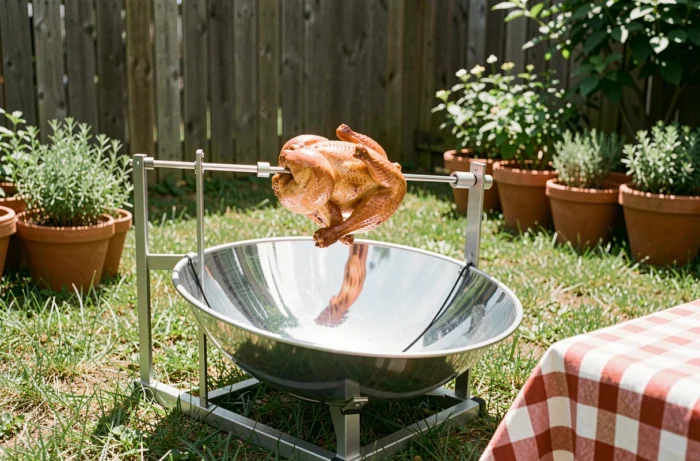
The solar rotisserie remains a niche item in the landscape of outdoor cooking equipment in France. A few specialized manufacturers offer parabolic or flat reflector models, but the majority of individuals have never seen this device in action. The principle relies on concentrating sunlight onto a focal point where the accumulated heat allows for roasting, grilling, or simmering food without fuel.
Online content widely promotes the ecological merits of solar cooking. Recent regulatory questions and the actual technical limitations of these devices deserve closer examination.
Solar Rotisserie and Prefectural Orders: An Underestimated Regulatory Ambiguity
The main argument for the solar barbecue is the absence of combustion. No charcoal, no gas, no visible smoke. This characteristic theoretically places it outside the scope of summer bans on open-flame barbecues.
The regulatory reality is more nuanced. Since the summer of 2026, several French prefectures (Gironde, Var, Bouches-du-Rhône, Vaucluse, Corsica, among others) have tightened their orders by prohibiting any cooking device producing flames or sparks outdoors, including on private property. A parabolic solar oven that reaches high temperatures can ignite cooking fats, potentially making it subject to these restrictions.
Some orders go even further by regulating any source of heat outdoors, which could include a very powerful solar cooker even without visible flames. Before organizing an ecological barbecue with Energie O’ Solr, it is essential to check the current orders in one’s department, as the mention of “solar” does not automatically grant an exemption.
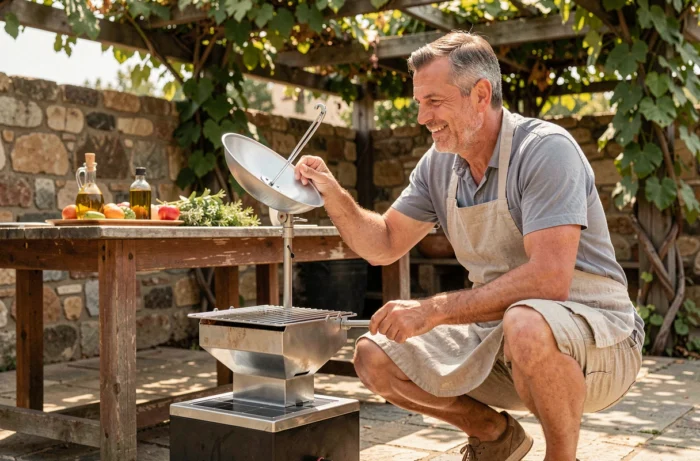
This legal ambiguity appears in almost no promotional content about solar barbecues. Field feedback varies on this point: some users report never having had a problem, while others have been reminded of the rules during periods of high fire risk.
Cooking with a Solar Rotisserie: What Temperature Really Allows
A parabolic solar barbecue can reach temperatures sufficient for grilling meat or vegetables. Reflector models concentrate light onto a central focal point where a spit or grill is placed.
Solar cooking fundamentally differs from charcoal or gas cooking in several technical aspects:
- The rise in temperature directly depends on sunlight: a cloudy spell interrupts or slows cooking, making preparation time unpredictable
- The adjustment of the reflector’s orientation must be regularly updated to follow the sun’s path, sometimes every fifteen to twenty minutes depending on the model
- The useful cooking area is generally smaller compared to a traditional barbecue, limiting the number of items cooked simultaneously
Solar cooking requires active presence and cooperative weather. It is not a device that you turn on and forget. For a friendly meal in the garden with several guests, one must anticipate a significantly longer cooking time than with a charcoal barbecue.
Taste Quality and Suitable Food Types
Slow cooking through solar concentration better preserves the nutrients and juices of food. Vegetables, poultry, and fish lend themselves well to this cooking method. Thick cuts of meat requiring quick searing at very high temperatures pose more challenges.
Classic grilling such as sausages or chops remains feasible, but the result differs from direct cooking over coals. The absence of combustion smoke alters the flavor profile: there is no characteristic smoky taste from charcoal, which may disappoint traditional barbecue enthusiasts.
Ecological Barbecue: Carbon Footprint Beyond Fuel
Eliminating charcoal or gas from cooking effectively removes direct CO2 and fine particle emissions at mealtime. This is the central environmental argument for the solar rotisserie.
A comprehensive analysis of the ecological footprint of a solar barbecue should also consider the manufacturing of the device. Parabolic reflectors use materials (polished aluminum, stainless steel, sometimes composites) whose production has a carbon cost. Available data does not allow for a conclusion on the number of cookings needed to “offset” this initial footprint compared to a traditional barbecue.
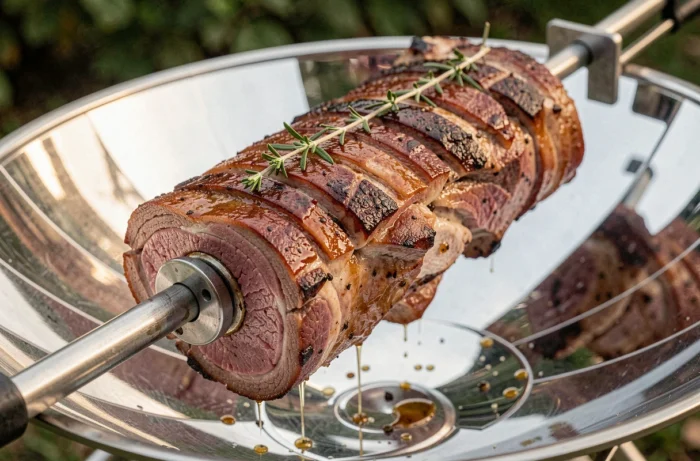
The Climate and Resilience Law, supplemented by decree n° 2022-452 of March 30, 2022, prohibits energy-intensive outdoor heating systems on public land. This regulatory framework strengthens the interest in passive solar solutions for outdoor cooking, even if domestic barbecues are not directly targeted by this text.
Choosing a Solar Rotisserie for Your Garden: Concrete Technical Criteria
The market remains limited in France, with a few specialized manufacturers like Solar Brother (which markets the Sunglobe) and imports of foreign models. Prices vary significantly based on the size of the reflector and the quality of materials.
Before purchasing, three technical parameters deserve special attention:
- The surface area of the reflector determines the heating power: a large-diameter reflector captures more radiation, but the device becomes bulky and more difficult to orient
- The system for securing the spit or grill must support the weight of the food without altering the alignment at the focal point
- The ease of disassembly and storage matters for seasonal use: some models fold, while others require permanent storage space
A quality parabolic reflector is not judged by its price but by its light concentration capability. A poorly polished or deformed mirror drastically reduces cooking efficiency.
Garden Exposure and Location Constraints
A south-facing garden with no shade between 11 a.m. and 4 p.m. offers the best conditions. Trees, walls, or buildings that cast shade on the cooking area significantly reduce efficiency. In northern regions of France, the effective cooking window is limited to May through September, and still contingent on sufficient sunlight.
The solar rotisserie does not replace versatile cooking equipment. It complements an existing outdoor kitchen for sunny days, making it a seasonal addition rather than a complete substitute for charcoal barbecues or gas planchas. This usage limitation, rarely highlighted, conditions the relevance of the investment based on geographical location and each household’s culinary habits.