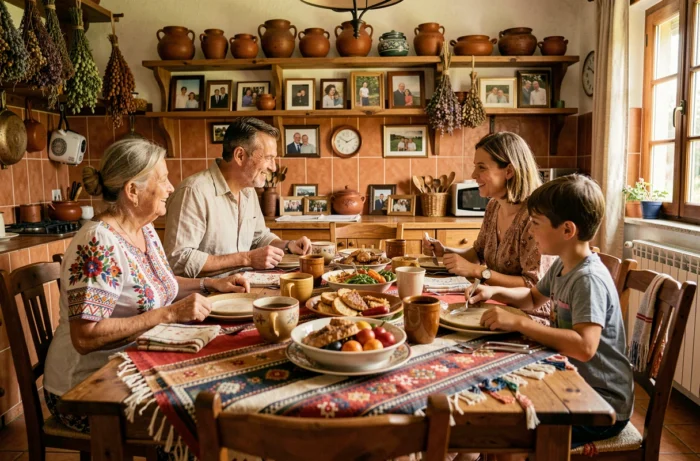
A parent’s educational choices do not arise in a vacuum. They bear the imprint of a mother tongue, an inherited relationship with authority, and social codes absorbed during childhood. Understanding how parents’ origins shape family life requires going beyond the simple observation of influence to examine the concrete mechanisms: transmission of norms, confrontation between educational models, and the weight of recent French legal frameworks.
Recent legal framework of parental authority and cultural origins
Since the law of February 19, 2024, Article 371-1 of the Civil Code includes two clarifications that change the game for all families: parental authority now also aims to protect the child’s private life, and it is exercised without physical or psychological violence. This legislative evolution is not neutral for parents whose cultural origins value stricter disciplinary practices or a different conception of the child’s intimacy.
The text does not target any specific community. It establishes a common foundation that applies to all parenting styles, regardless of family tradition. For parents raised in a model where physical correction was normalized, this prohibition creates a gap between what they experienced and what the law expects of them.
This gap is not always accompanied: the available data does not allow for precise measurement of how many families adapt their practices after such a legislative change.
Family history weighs on daily choices, from the approach to discipline to academic expectations. An article dedicated to the origins of parents on Maman Double precisely explores this dynamic.
Transmission of educational norms between generations
Social science research has been using sibling models for several decades to isolate the influence of the family environment on educational and professional trajectories.
The usual variables (parents’ diploma and profession) underestimate the real influence of the family. They overlook unobservable family aspects, such as the values transmitted at the table, the language spoken at home, or the relationship to knowledge.

In other words, two families with identical diploma levels but different cultural origins do not produce the same trajectories for their children. The share of influence that escapes classical surveys is precisely tied to these immaterial legacies: relationship to error, place of orality, value placed on individual success versus family collective.
What classical surveys do not capture
Statistical models measure the father’s diploma, the mother’s socio-professional category. They miss several factors related to origins:
- The language in which a parent scolds or encourages their child, which influences the emotional register of education and bilingualism experienced as an asset or a school handicap.
- The internalized model of authority: some traditions favor a vertical family hierarchy, while others encourage negotiation from a young age.
- The social network available for guidance, which strongly depends on the parents’ length of residence in a territory and their mastery of French institutional codes.
These elements, difficult to quantify, weigh heavily at the time of educational orientation choices.
Educational orientation: when family expectations meet the French system
The Avenir Plan presented by the Ministry of National Education in 2025 has an explicit goal: to reduce the effects of social, geographical origins, and gender on orientation choices. This plan places orientation within a logic of emancipation, which amounts to officially recognizing that a child’s educational journey remains strongly correlated with their background.
For families from immigration or newly settled in France, mastery of official digital tools (online forms for choices after the 3rd grade, orientation procedures in the second year) constitutes an additional filter. These services exist, but their use is still presented as optional, creating an asymmetry: parents already familiar with the system seize them, while others sometimes discover the procedures too late.
Parental expectations and pressure on career choice
Research in career psychology shows that parental influence on career choice far exceeds verbal advice. It comes through family narratives (a grandfather who was a craftsman, a mother who sacrificed her studies), through silences as well (professions that are never discussed at home), and through implicit projections of what a “good path” means.
In some families, academic success carries a symbolic weight related to migration: the child must “make the move of their parents worthwhile.” This pressure, rarely expressed directly, guides adolescents towards fields perceived as safe (medicine, law, engineering) at the expense of different personal aspirations. Field reports diverge on this point: some young people find it a driving force, while others see it as confinement.

Bicultural family life: tensions and negotiations in daily life
Raising a child between two cultures is not just about choosing a language or a name. Tensions arise on concrete issues: the age at which a teenager can go out alone, the mixing of activities, the place of religion in education, the relationship to the body and modesty. An article from Courrier International reminds us that raising children abroad means “necessarily doing things differently,” without this difference always being conscious or acknowledged.
Mixed couples constantly negotiate these gaps, often without a common framework. The parent whose educational references align with the dominant model of the country has an implicit advantage: schools, doctors, and other parents “naturally” validate their choices. The other parent finds themselves in a position of having to justify their practices.
This asymmetry cannot be resolved by a single compromise. It plays out at every stage of the child’s development, from early childhood to post-baccalaureate orientation choices. Parental educational coherence depends less on theoretical agreement than on repeated micro-negotiations on very concrete issues.
The weight of origins on family life and education does not disappear over time. It transforms, sometimes transmitted in attenuated forms, sometimes amplified by a school context that still struggles to account for the real diversity of family models. The Avenir Plan and the reform of parental authority outline a framework, but it is in the intimacy of homes that the negotiations take place, far from official texts.