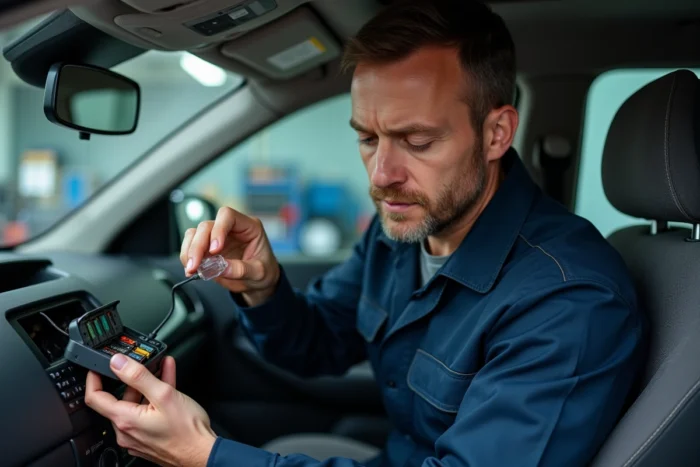
You press the button on your remote control, and nothing happens. The doors remain closed, the usual click of the central locking does not sound. Before suspecting an expensive problem with the lock motor or the electronic card, there is a component worth your attention that costs only a few cents: the fuse that protects the central locking circuit. This small element, often overlooked, can immobilize the entire door locking system in a fraction of a second.
The central locking fuse protects the lock actuators
Each door of your car contains a small electric motor (called an actuator) that pushes or pulls the locking rod when you use the remote control or the interior button. These motors consume current with each activation.
The fuse dedicated to central locking is a calibrated metal wire, inserted into a plastic housing, that intentionally melts if the current exceeds a given threshold. Its role is to cut the circuit before an overload damages the actuators or wiring. A short circuit in a door lock, a stuck actuator that forces, a wire pinched under a trim panel: these are all situations where the fuse sacrifices itself to protect the rest of the installation.
To better understand the operation of the central locking fuse on Carfully, keep this simple principle in mind: the fuse does not control anything, it monitors. As long as the current remains within the specified limits, it allows it to pass. As soon as the threshold is crossed, it cuts everything off, instantly.
Fuse box: where to find the central locking fuse
You have identified the symptom (doors that no longer respond), and you suspect the fuse. Now you need to find it. The location varies significantly from one manufacturer to another, and even from one model to another within the same brand.
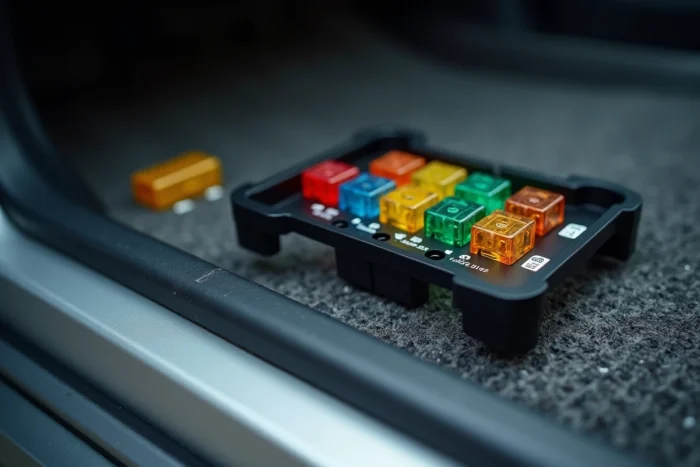
Two main locations are common across most vehicles:
- Fuse box under the dashboard, on the driver’s side, often accessible by pulling a cover under the steering wheel or to the left of the pedal area. This is the most common location for the central locking fuse.
- Fuse box in the engine compartment, usually near the battery. This box typically contains high-power fuses, but some manufacturers also house the door locking circuit protection there.
- On a few models (some Korean or Japanese vehicles), a third box may be located in the trunk or under the rear seat, complicating the search.
Your best ally remains the cover of the fuse box itself. A diagram is printed there with the designation of each fuse. Look for mentions of “central locking,” “door lock,” “verrouillage,” or sometimes simply “portes.” The vehicle’s maintenance manual also reproduces this diagram.
Recent vehicles: the fuse is not always visible
Here’s a point that classic guides rarely address. On cars produced in recent years, central locking is no longer protected by a dedicated fuse that is easily identifiable in the box.
The reason: the door locking circuit is now controlled by a body electronic module, known as BCM (Body Control Module) at Volkswagen, or UCH (Unité de Commande Habitacle) at Renault. This module centralizes the management of several functions (lighting, wipers, locking) and integrates its own electronic protection logic.
In practice, the fuse panel sometimes only has a line labeled “BCM” or “Body” or “Carrosserie,” without explicit mention of locking. The module itself cuts or limits the current in case of a fault in the locks, actuators, or remote control receiver. If this “BCM” fuse blows, a whole set of functions fails simultaneously, not just the doors.
This architecture explains why, on a recent vehicle, a central locking failure accompanied by other symptoms (inactive dome light, silent turn signals) points more towards the body module than a simple lock fuse.
Diagnosing a blown fuse: concrete steps
Before replacing anything, you need to confirm that the fuse is indeed the issue. There are two methods, from the quickest to the most reliable.
Visual inspection of the fuse
Remove the suspected fuse using the plastic pliers usually provided in the cover of the box. Look at the metal filament through the transparent housing. A broken or blackened filament indicates a blown fuse. This method works in most cases, but some fuses may appear intact visually while being faulty.
Multimeter test to eliminate doubt
Set a multimeter to continuity mode (diode symbol or sound signal). Place the two probes on the metal contacts of the fuse. If the device beeps or shows a resistance close to zero, the fuse is good. No signal: it is blown.

The replacement itself is simple: insert a new fuse of the same amperage as the original. Using a higher-rated fuse removes the protection and exposes the wiring to a risk of overheating or even fire. The rating is marked on the fuse and is also shown in the diagram on the cover.
Repeatedly blowing fuse: a symptom, not the failure
A central locking fuse that blows once may be an isolated incident. A fuse that blows again after replacement indicates a persistent fault in the circuit. Replacing the fuse repeatedly without investigating the cause is like ignoring a warning light.
The most common causes of a repeatedly blowing locking fuse:
- A mechanically stuck door actuator, which draws excessive current by forcing on the rod.
- A bare or pinched wire in a door passage, creating an intermittent short circuit with each opening or closing.
- Water infiltration into the lock mechanism, causing corrosion that eventually contacts two conductors.
- A faulty control relay that sends continuous current instead of brief pulses.
A fuse that keeps blowing indicates an upstream electrical problem that requires further diagnosis, often with a fault code reading tool on the body module. Entrusting the vehicle to an automotive electrician at this stage prevents turning a simple wiring issue into a complete harness replacement.
One last point to keep in mind: if your vehicle no longer locks the doors and the remote seems inactive, also check the key battery before disassembling the fuse box. A weak battery produces exactly the same symptom as a blown fuse, without any component in the circuit being at fault.