
Buying on Cdiscount exposes the buyer to a stack of protections that do not all fall under the same legal regime. Legal compliance warranty, commercial warranty from the marketplace seller, optional insurance linked to the Cdiscount card: these three layers coexist on the same order, without their scopes coinciding. Understanding how they work helps avoid wasting time with a seller who refers to the insurer, while the insurer refers back to the seller.
Legal warranty and commercial warranty on Cdiscount: two distinct regimes
The legal compliance warranty applies to all products sold on Cdiscount, including those offered by third-party sellers on the Marketplace. The product sheets on the site remind us: a commercial warranty does not replace either the legal compliance warranty or that for hidden defects. This point is often misunderstood by buyers who think that subscribing to a paid extension covers them better than the law.
The commercial warranty, on the other hand, is a voluntary commitment from the seller or manufacturer. Its duration, conditions, and exclusions vary from one marketplace seller to another. Some Cdiscount listings display coverage for parts and labor, sometimes supplemented by a separate supplier warranty for parts only.
For those who want to know everything about the Cdiscount warranty, the distinction between these two regimes is the foundation to master before considering any additional paid options.
A common trap: a marketplace seller may offer a commercial warranty with restrictive conditions (return to sender at your expense, unregulated processing time), which gives the illusion of protection while the legal warranty would provide a more direct and protective recourse.

Marketplace seller, Cdiscount, and card insurance: who intervenes in case of dispute
Here’s the scenario that the help pages do not detail: a product purchased from a third-party seller breaks down. The buyer has subscribed to the insurance linked to the Cdiscount card (via Floa). They theoretically have three recourses. In practice, each of these recourses points to a different contact, with incompatible activation conditions.
- The marketplace seller is responsible under the legal compliance warranty, but their after-sales service may be based outside France, with long response times and a return procedure theoretically at their expense, contested in practice.
- The potential commercial warranty from the seller or manufacturer often imposes specific conditions (serial number, original packaging, declaration within a short timeframe) that can invalidate the claim if not strictly adhered to.
- The Cdiscount card insurance covers certain purchases against breakage or theft, with mechanisms for “successful delivery” and best price, but these protections do not cover classic breakdowns related to compliance.
The concrete result: the buyer contacts the seller, who directs them to the manufacturer. The manufacturer invokes an exclusion from their commercial warranty. The buyer then turns to the card insurance, which refuses because the claim falls under compliance and not an accidental damage. Each party refers to the scope of the other without any of them taking charge of the case.
Breaking the cycle of referrals
The rule to remember: the legal compliance warranty takes precedence over commercial warranties and optional insurances. If the product has a compliance defect, it is the seller (marketplace or Cdiscount directly depending on the case) who must respond. The buyer does not have to prove the origin of the defect during the period covered by the legal presumption of prior existence.
Sending a written formal notice to the seller explicitly invoking the legal compliance warranty remains the most effective lever to unlock a case stuck between three parties.
Refurbished products on Cdiscount: longer return periods, warranty to check
Cdiscount Seconde Vie grants a return period of 30 days on refurbished products, where the legal withdrawal period for a distance purchase is 14 days. This extended period allows more time to detect a defect, but it does not replace the legal compliance warranty, which runs well beyond.
For a refurbished product, the issue of compliance arises differently. The condition of the product is described according to a grade (like new, very good condition, good condition), and any discrepancy between the description and reality constitutes a legal compliance defect. A screen with scratches not mentioned in the product sheet, for example, entitles the buyer to recourse even after the 30-day return period has expired.
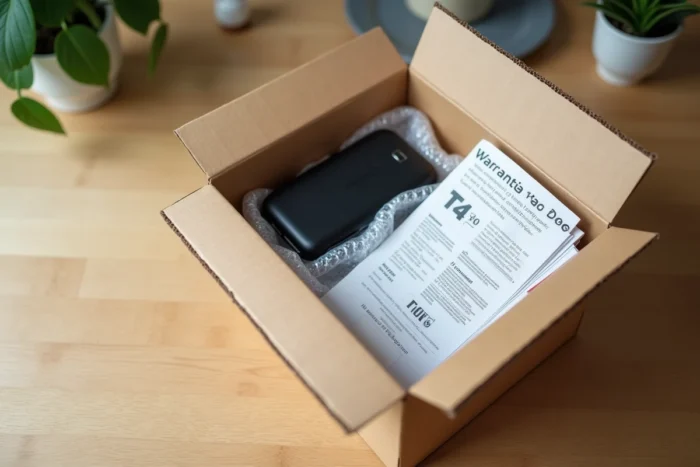
Cgaranti insurance for breakdowns and breakage: what this paid option really covers
The Cgaranti insurance offered at the time of purchase on Cdiscount covers breakdowns occurring after the expiration of the legal compliance warranty, as well as accidental material damage. The contract, taken out with a third-party insurer, operates on an individual membership basis with a one-time fee.
Two points deserve attention:
- The member must keep the order acknowledgment and the invoice proving the payment of the fee. Without these documents, coverage may be denied.
- A withdrawal period of 14 days applies from the payment of the fee, allowing cancellation of the insurance if you believe it overlaps with another existing coverage (home insurance, personal credit card).
- Only one warranty option can be chosen per device and per membership: it is therefore necessary to check before confirming whether the coverage applies to breakdowns only, breakage only, or both combined.
Overlap with your credit card insurance
Many premium credit cards already include an extension of the manufacturer’s warranty or insurance against breakage/theft on purchases. Subscribing to Cgaranti without checking what your own card covers amounts to paying twice for a risk already covered. The pre-contractual information sheet for Cgaranti actually encourages the buyer to check if they are already a beneficiary of a warranty covering the same risks.
On a Cdiscount purchase, the strongest protection remains that which the law imposes on the seller. Optional insurances and commercial warranties add layers that may provide reassurance, but their activation in a concrete case often encounters conditions that the buyer discovers at the time of the claim. Checking existing coverage before ticking an additional box in the cart remains the most cost-effective reflex.